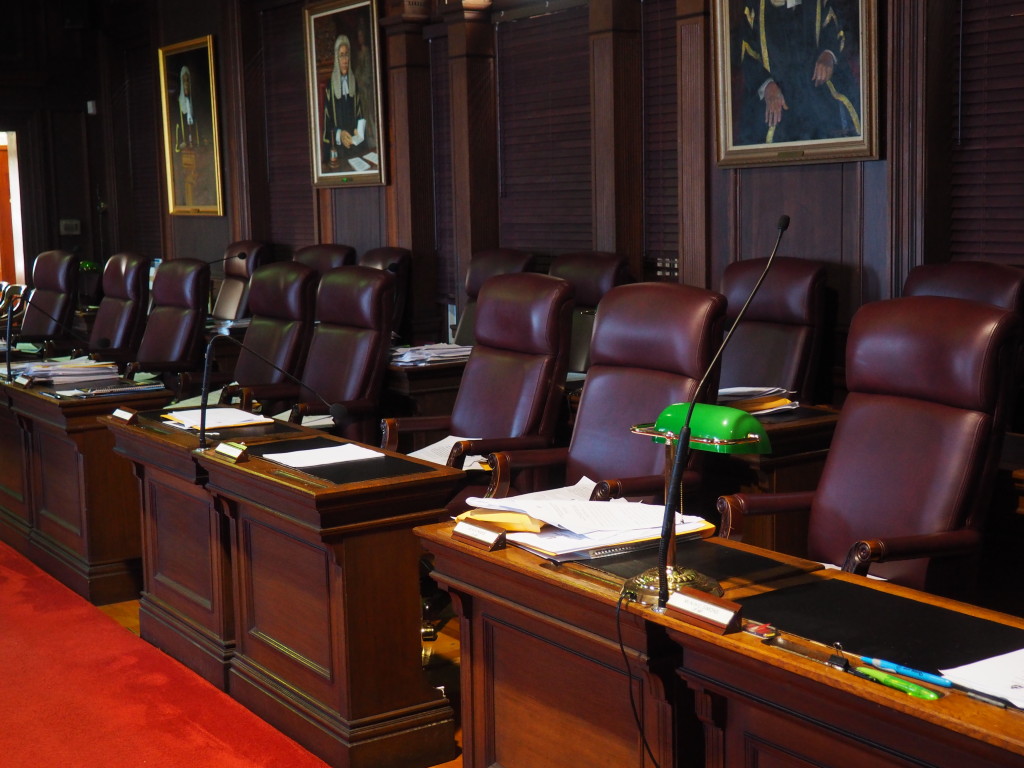
Bermuda’s Opposition boycotted parliament before the summer recess in protest against the Governor’s decision. Could court action be next?
Bermuda’s Opposition Progressive Labour Party has been mulling court action to force Governor George Fergusson to reconsider his refusal to set up a Commission of Inquiry into historic land grabs.
PLP Leader Marc Bean confirmed that the party is examining the possibility of a judicial review but would not elaborate.
Public law expert Nicola Barker told Politica that a challenge of the Governor’s decision would stand some degree of success.
Some legal eagles disagree, saying the Governor has created enough wriggle room to make his position unassailable in the courtroom.
And there is some concern about the possible costs of any action – especially if the party loses and costs are awarded to the UK government.
A motion passed by the House of Assembly on July 4 asked the Governor to establish a Commission of Inquiry into claims of “historic losses in Bermuda of citizens’ property through theft of property, dispossession of property and adverse possession claims”; and “to determine, where possible, the viability of any such claims and make recommendations for any victims of wrongful action to receive compensation and justice.”
Governor Fergusson who has final approval under Bermuda’s colonial constitution declined to sign off on it saying he would reconsider if the House provided more clarity on the types of abuses being alleged and a “clearer mandate” to spend taxpayer funds.
Nicola Barker, a law professor at the University of Kent who was visiting Bermuda last month, said that Fergusson’s stance could be subjected to a judicial review or as a breach of the European Convention of Human Rights.

Dr Nicola Barker, University of Kent law professor Photo: Ayo Johnson
Governor Fergusson’s honorary membership of the Mid Ocean Club – which he gave up days before announcing his decision – and the fact that he consulted with the governing One Bermuda Alliance, which opposed the motion could be presented as evidence of an appearance of bias, Dr Barker said.
“The governor is supposed to be politically neutral and so meeting with the Premier could be taken to be seen as having been lobbied by the Premier on this issue” she said.
“That’s one aspect of it, the other aspect of it is the fact that he belonged to this club – the Mid Ocean Club. And the fact that he was a member of that club he could be considered to be a judge in his own cause, that he’s taken a decision that could potentially have an impact on the club he is a member of.”
A local lawyer who declined to be named for this story said that while the appearance of bias argument may sound appealing, it was unlikely to succeed because only the Governor could make the decision.
“He’s the only person who can make the decision and the law makes an exception in those cases,” he said.
Barker agrees that finding an alternative decision-maker may be problematic, but she went on to say that even filing a claim could cause the UK Foreign Office to act.
“Judicial review is most effective when public authorities are embarrassed by it or don’t want to have to go to court and defend their position. As a legal remedy itself its not necessarily effective,” she said.
“In most cases, the decision is returned to the decision maker in order to make the decision again but in line with the proper legal procedure. So if a judicial review case is taken on bias, and won, I don’t know who the alternative decision maker would be.
“Potentially someone else would have to take the decision but I don’t know who that person would be. So, its possible that simply filing the claim would cause the governor and the FCO to reconsider their position – whether it changes their mind or not I don’t know, but it might cause them to reconsider their position rather than have the potential embarrassment of losing a judicial review claim.”
Failing a judicial review challenge in the UK, proceedings could be instituted in the European Court of Human Rights, according to Barker. Land grab victims would have effectively been denied their right to an effective remedy – guaranteed by Article 13 of the European Convention of Human Rights – by the Governor’s decision not to establish a Commission of Inquiry.
“You could argue that those people who lost their land in these incidents have been denied an effective remedy because the statute of limitations is expired and they can’t take a civil claim as far as I’m aware to redress this wrong and so really the only effective remedy available to them now is to hold a public inquiry and to hold the people responsible to account – not necessarily financially – but through a process of ‘this is what happened, we acknowledge that this happened and here’s an apology’.
“It’s really the least that can be done. But that is arguably the only effective remedy. And that has been denied to them by the action of the Governor in refusing to hold an inquiry.”
As the most constitutionally advanced of Britain’s 14 remaining overseas territories, Bermuda is something of an anomaly: she is, de facto, a largely self-governing island; however, the Governor retains important functions that often only come into the light when events force their appearance.
Thus, under Section 35 of Bermuda’s Constitution, Fergusson has the power to “reserve for the signification of Her Majesty’s pleasure” any bill that is inconsistent with the UK’s international obligations, which might affect the Royal Prerogative, which is inconsistent with the Governor’s reserved powers or which is ‘repugnant’ to the constitution.
The UK Government can even “disallow” bills relating to Government stock, or Bermuda’s public debt, which have been assented to by the legislature and the Governor.
A 2012 White Paper by the FCO stated the matter clearly: “As a matter of constitutional law the UK Parliament has unlimited power to legislate for [British Overseas] Territories.”
An FCO spokesman confirmed to Politica in May that “the UK can override legislation and other constitutional arrangements in Bermuda… given that the Bermuda Constitution is an instrument of the British Parliament.”
Meanwhile, the Commission of Inquiries Act 1935 gives the Governor the power “whenever he considers it advisable, [to] issue a commission appointing one or more commissioners and authorising them, or any quorum of them therein mentioned, to inquire into…any matter in which an inquiry would in the opinion of the Governor be for the public welfare”.
In a letter to House of Assembly Speaker Randolph Horton on July 10, 2014, Fergusson put it: “The decision to appoint a Commission therefore falls to the Governor.”
However, he added: “In deciding whether or not to appoint a Commission, a recommendation from the House of Assembly carries considerable weight and I have taken this into account carefully.”
Fergusson summed up his decision by stating that he believed the admittedly “serious concerns” raised by the House of Assembly’s motion were “not clear or urgent enough to justify a Commission of the kind proposed”.
The response infuriated the Progressive Labour Party which announced a boycott of parliament until the matter is resolved.
PLP leader Marc Bean called for the recall of the Governor and the dissolution of parliament.
He told a mass protest at Government House that further action must follow should the FCO not heed the demands.
Overseas Territories Minister Mark Simmonds has rejected the Opposition’s demands and expressed full confidence in Governor Fergusson.
On July 18, the final sitting of the House of Assembly before the summer recess, Bean hinted at some flexibility in his party’s decision to boycott parliament.
This article belongs to Politica ! The original article can be found here: Judicial review mulled over Governor’s land grab decision
Politica © 2026 - All Rights Reserved
